Products
About Us

Technical Support

Oct. 07, 2026
Share:A mesh belt sintering furnace is widely used for continuous heat treatment of powder metallurgy components. Unlike a batch furnace, workpieces travel continuously through different process zones on a heat-resistant mesh belt, allowing heating, sintering and cooling to be integrated into a continuous production line.
However, selecting and operating a mesh belt sintering furnace involves more than setting a target temperature. Material composition, debinding requirements, protective atmosphere, belt loading, conveying speed, heating-zone configuration and cooling conditions can all influence the sintering process.
This guide explains how a continuous mesh belt sintering furnace works, the main stages of the powder metallurgy sintering process, the role of protective atmosphere and cooling, suitable applications, and the key parameters buyers should evaluate when planning a production line.
A mesh belt sintering furnace is a continuous industrial furnace that transports workpieces through the furnace on a moving metal mesh belt. It is commonly considered for repetitive production where parts require controlled heating under a specified process atmosphere followed by controlled cooling.
In powder metallurgy production, pressed components can be loaded onto the belt and moved through different sections of the furnace according to the required process. Depending on the material and production requirements, the line may include debinding or preheating, high-temperature sintering and cooling sections.
The conveying speed, effective heating length and temperature-zone arrangement determine how long the workpieces remain in each stage. For this reason, furnace performance should not be evaluated only by its maximum operating temperature. The complete temperature profile, atmosphere conditions, loading method and production capacity must be considered together.
Continuous operation can be particularly useful for standardized powder metallurgy components produced in repeated batches because the furnace can maintain a consistent material flow through the defined process stages.
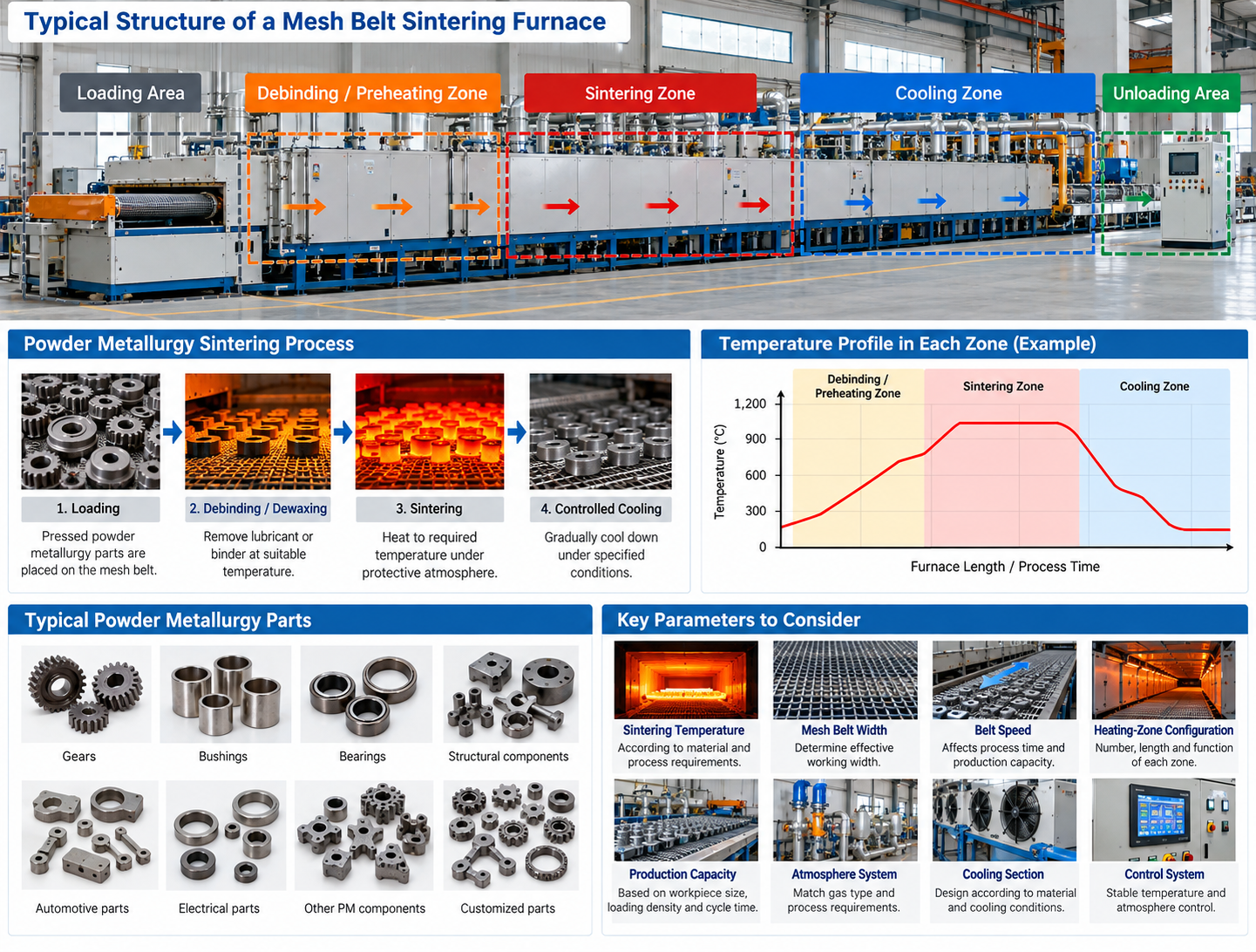
In powder metallurgy production, sintering is the thermal process used to bond compacted powder particles and develop the required properties of the component. For a continuous mesh belt furnace, the complete process normally involves several stages rather than a single heating step.
The exact process depends on the powder composition, lubricant or binder, part geometry and required final properties. A typical continuous line may include debinding or dewaxing, preheating, sintering and controlled cooling.
Before the main sintering stage, lubricants or binders used during powder compaction may need to be removed from the parts.
This stage is often referred to as debinding or dewaxing. The removal conditions must be matched to the material and binder system so that the parts can enter the subsequent heating stages under suitable process conditions.
The furnace configuration for this section should therefore be determined according to the actual powder and production process rather than treated as a fixed standard configuration.
After the initial debinding stage, the parts continue through the heating sections as their temperature increases toward the required sintering range.
A controlled heating profile helps prepare the workpieces for the main sintering stage. The required heating rate and residence time depend on the material, part dimensions, loading arrangement and process specification.
In the main sintering zone, the compacted powder metallurgy parts are heated according to the required material and process conditions. During this stage, bonding develops between powder particles and the component develops its required metallurgical properties.
The required sintering temperature and holding time vary according to the material system. For a continuous furnace, residence time is influenced by factors such as effective zone length and mesh belt speed.
This is why a suitable powder metallurgy sintering furnace should be designed around the required process rather than selected only according to its maximum temperature.
After leaving the main sintering zone, the parts enter the cooling section. Cooling conditions are an important part of the complete sintering cycle and should be matched to the material, atmosphere and required final properties.
In a continuous production line, atmosphere protection may also need to be maintained during relevant cooling stages before the parts are exposed to the surrounding air.
The complete process can therefore be understood as:
Loading → Debinding / Dewaxing → Preheating → Sintering → Controlled Cooling → Unloading
Protective atmosphere is one of the key process conditions in powder metallurgy sintering. During heating and cooling, the surrounding furnace atmosphere can influence the surface condition of the parts and the stability of the sintering process.
A controlled atmosphere sintering furnace is designed to maintain the required process environment through the relevant furnace zones. The appropriate atmosphere depends on the powder composition, sintering temperature, lubricant or binder system, and the required properties of the finished component.
Depending on the application, nitrogen, hydrogen-containing mixtures or other specified process gases may be used. The correct gas type, composition and flow conditions should be determined according to the actual material and established sintering process.
Atmosphere control should not be considered separately from the furnace itself. Furnace sealing, gas introduction, heating-zone arrangement, exhaust design and cooling section all need to work together to maintain suitable process conditions.
For buyers comparing powder metallurgy sintering furnaces, it is therefore important to provide the required atmosphere or existing process specification when requesting a quotation. If the process is already running successfully on another furnace, information about the existing atmosphere and production conditions can also help the furnace manufacturer evaluate a suitable configuration.
There is no single protective atmosphere suitable for every powder metallurgy material. The selection depends on the material system and the purpose of the process.
Nitrogen-based atmospheres may be used in suitable powder metallurgy processes where the material and process requirements allow.
Hydrogen-containing atmospheres may be specified for applications that require reducing conditions. Their composition and use must be determined according to the actual material, process and safety requirements.
Other controlled atmosphere configurations may also be required for specific materials or production processes. Buyers should avoid selecting a furnace based only on a general description such as “protective atmosphere furnace” without confirming the actual gas and process requirements.
When preparing a furnace inquiry, it is useful to provide the material grade, existing atmosphere composition, required sintering temperature and desired surface condition. These details allow the furnace and atmosphere system to be evaluated together.
Mesh belt sintering furnaces are commonly considered for powder metallurgy components that can be transported continuously and arranged reliably on the conveyor belt during the heating and cooling process.
Typical applications may include PM gears, bushings, bearings, structural components and other pressed metal parts produced in repetitive quantities. Iron-based and copper-based powder metallurgy components are common applications for continuous sintering, provided that the required material, temperature, atmosphere and loading conditions are suitable for the furnace design.
However, part shape and material alone do not determine whether a mesh belt furnace is suitable. The furnace manufacturer should also evaluate the dimensions and weight of each part, loading density, required production capacity, sintering temperature and atmosphere requirements.
Very heavy components, unusual geometries, special materials or processes requiring conditions outside the practical operating range of a mesh belt system may require another furnace configuration.
For this reason, buyers planning a continuous powder metallurgy production line should provide workpiece drawings or clear photos together with material and capacity information before the furnace configuration is finalized.
For suitable applications, continuous processing allows powder metallurgy parts to move through defined process stages without loading and unloading separate furnace batches.
A continuous mesh belt sintering furnace can combine material feeding, heating, sintering and controlled cooling in one production flow. Belt speed and furnace-zone configuration can then be matched to the required processing time and production capacity.
This type of system can be particularly useful for manufacturers producing standardized parts repeatedly, where stable process conditions and continuous production flow are important.
The main advantage is not simply that the furnace operates continuously. A properly configured line allows the workpiece, temperature profile, atmosphere, conveying speed, loading arrangement and cooling process to be considered as one complete production system.
One of the key decisions in powder metallurgy production is whether to use a continuous mesh belt furnace or a batch sintering furnace. The correct choice depends on the workpiece, material, process conditions, production volume and required production flexibility.
A continuous mesh belt sintering furnace transports parts through the furnace at a controlled belt speed. For suitable powder metallurgy applications, different sections of the line can perform debinding or preheating, sintering and controlled cooling as part of one continuous process.
This configuration is generally better suited to repetitive production where similar components are manufactured continuously and the required process can be maintained within the operating conditions of the mesh belt system.
Continuous operation also makes production capacity closely related to factors such as belt width, loading arrangement, conveying speed and effective furnace-zone length.
A batch furnace processes a defined load of workpieces in one operating cycle. Depending on the process, it may be more suitable when production quantities are lower, product types change frequently, or the required material and process conditions are not appropriate for continuous mesh belt conveying.
Batch processing can also provide greater flexibility for applications where different products require significantly different process cycles.
Neither furnace type is automatically better for every application. A manufacturer producing large quantities of similar PM components may benefit from continuous processing, while another manufacturer handling smaller batches or frequently changing products may require a different furnace configuration.
Before making the decision, compare the workpiece material, part dimensions and weight, production capacity, sintering temperature, protective atmosphere, loading method and required process cycle.
The furnace should ultimately be selected according to the production process rather than simply choosing “continuous” or “batch” based on furnace price.
When comparing mesh belt sintering furnaces, maximum temperature and overall furnace dimensions are not enough to determine whether a system is suitable. The furnace should be evaluated according to the complete production process and actual workpiece requirements.
The required sintering temperature depends primarily on the powder metallurgy material and process specification. It affects the furnace heating system, insulation structure, conveyor design and other components exposed to the process temperature.
Buyers should provide the normal operating temperature and required process range rather than selecting equipment only according to the highest temperature shown in a furnace specification.
Mesh belt width affects how many parts can be arranged across the conveyor and therefore influences production capacity. However, the nominal belt width should not automatically be treated as the usable loading width.
Workpiece dimensions, spacing between parts and loading arrangement should be considered when determining the effective working width.
In a continuous sintering furnace, mesh belt speed is closely related to the time the workpieces remain inside each process zone.
The required belt speed should therefore be evaluated together with the effective length of the heating and sintering zones. Simply increasing conveyor speed to obtain higher output may reduce the available process time and may not meet the required sintering cycle.
A continuous furnace may contain several controlled heating sections according to the required process. The number, length and function of these zones should be determined according to the temperature profile and required residence time.
When comparing quotations, buyers should check the effective working-zone dimensions rather than comparing only the external dimensions of the complete furnace line.
Required output should be defined as clearly as possible, such as the expected quantity or weight of acceptable parts produced per hour or per day.
Production capacity is influenced by workpiece dimensions, individual weight, loading density, belt width, conveying speed and process time. For this reason, a meaningful capacity calculation requires actual workpiece information.
The atmosphere system should match the powder material and established sintering process. Buyers should specify the required process gas or existing atmosphere composition whenever this information is available.
Gas introduction, furnace sealing, exhaust arrangements and atmosphere protection through the relevant process zones should be considered as part of the complete furnace design.
The cooling section must be considered when determining the complete line configuration. Its design depends on factors such as the material, production rate, required cooling conditions and atmosphere requirements.
Buyers should therefore compare the complete heating–sintering–cooling process, rather than evaluating only the high-temperature section of the furnace.
When sintered parts do not achieve the expected surface condition, dimensions or consistency, the furnace itself is not always the only cause. Material, compaction, loading, temperature profile, atmosphere and cooling conditions should be checked together.
If parts show unexpected oxidation or discoloration, check the protective atmosphere, furnace sealing, gas supply and the point at which parts are exposed to air.
Variation between parts may be related to loading density, temperature distribution, belt speed or differences in residence time. The actual loading pattern should therefore be considered when evaluating process stability.
Residual lubricant or binder may indicate that the debinding conditions are not suitable for the material, loading arrangement or production rate. The debinding stage should be evaluated together with the subsequent heating process.
Dimensional changes during sintering are influenced by the powder material, compaction conditions and thermal cycle. If dimensional consistency becomes a problem, both the material process and furnace temperature profile should be reviewed.
Long-term operation places thermal and mechanical demands on the conveyor system. Belt loading, operating temperature, belt condition, alignment and drive system should be checked as part of routine furnace maintenance.
Troubleshooting should therefore focus on the complete material–furnace–atmosphere–conveyor–cooling system, rather than changing one furnace setting without identifying the cause.
You do not need to prepare a complete technical specification before contacting a furnace manufacturer. For an initial evaluation, a few basic details are usually enough:
1. What parts do you need to sinter?
A photo or drawing is helpful.
2. What is the material?
For example, iron-based or copper-based powder metallurgy parts.
3. What sintering temperature do you require?
If you are not sure, provide your existing process information if available.
4. What production capacity do you need?
An approximate hourly or daily output is enough for the initial discussion.
With these basic details, the furnace manufacturer can first evaluate the suitable furnace type and general configuration. Additional information such as protective atmosphere, loading arrangement, power supply and installation space can be confirmed during the technical discussion.
Not sure about all the parameters? Send us your workpiece photo or drawing first, and we can start from there.
A mesh belt sintering furnace is used for continuous thermal processing of suitable components transported through the furnace on a metal mesh belt. In powder metallurgy, it can be used for continuous processing of compatible iron-based, copper-based and other PM components according to the required material and process conditions.
A mesh belt furnace processes parts continuously, while a batch furnace processes a defined load in each cycle. Continuous furnaces are often considered for repetitive production of similar parts, while batch systems may offer more flexibility when products or process cycles change frequently.
The required atmosphere depends on the material and sintering process. Nitrogen-based, hydrogen-containing or other specified process atmospheres may be used depending on the application. The gas composition should be confirmed according to the actual material and process requirements.
Furnace capacity depends on several factors, including part dimensions and weight, loading density, mesh belt width, belt speed and required process time. Providing a workpiece photo or drawing and an approximate hourly or daily output is usually enough to begin an initial evaluation.
Yes. The furnace configuration can be designed according to the workpiece, material, process temperature, atmosphere and production requirements. Working dimensions, heating zones, conveyor system and cooling section can be evaluated according to the actual application.
A mesh belt sintering furnace should be considered as a complete production system rather than simply a high-temperature heating chamber. The workpiece, temperature profile, protective atmosphere, belt conveying system and cooling process all need to work together.
For suitable powder metallurgy applications, continuous mesh belt processing can provide an efficient production flow from loading through sintering and controlled cooling.
Rexin provides customized continuous sintering furnace solutions based on actual workpiece and process requirements.
Planning a powder metallurgy sintering project? Send us a workpiece photo or drawing, material, required temperature and approximate production capacity. We can start with these basic details and help evaluate a suitable furnace configuration.
If you’re interested in our heat treatment furnaces or customized solutions, contact us for professional support and tailored quotations. We look forward to long-term win-win cooperation.