Products
About Us

Technical Support

Sep. 07, 2026
Share:An industrial heat treatment furnace is not selected by temperature and chamber size alone. The right furnace must be engineered around the material, workpiece geometry, heat treatment process, production capacity, furnace atmosphere, temperature uniformity, and cooling requirements.
For manufacturers, the real question is not simply “Which furnace should I buy?” but “Which furnace configuration can consistently achieve the required metallurgical result at the required production capacity?”
The correct furnace must match the workpiece material, heat treatment process, production capacity, protective atmosphere, temperature uniformity, cooling method, quality requirements, and factory operating conditions.
For manufacturers of automotive components, fasteners, powder metallurgy parts, stainless steel tubes, bearings, aluminum components, tools, radiators, and other metal products, an incorrectly selected furnace can result in unstable hardness, oxidation, distortion, insufficient density, high energy consumption, inconsistent product quality, or excessive production costs.
This guide explains the major types of industrial heat treatment furnaces, common heat treatment processes, typical applications, important technical specifications, and the key information manufacturers should evaluate before purchasing a furnace.
Whether you are replacing an existing furnace, expanding production capacity, or building a new heat treatment line, this guide will help you understand how to select a furnace that matches your actual production requirements.
An industrial heat treatment furnace is equipment used to heat, hold, and cool metal components under controlled conditions in order to achieve specific metallurgical, mechanical, dimensional, or surface properties.
Unlike a general heating oven, a heat treatment furnace must precisely control several process variables.
Different materials and heat treatment processes require different temperature ranges.
For example, tempering may take place at relatively moderate temperatures, while annealing, brazing, sintering, carburizing, or solution treatment may require considerably higher temperatures.
The furnace must therefore provide not only sufficient maximum temperature but also stable control throughout the required operating range.
The workpiece must remain at the required temperature long enough for the desired metallurgical transformation to occur.
Insufficient holding time may result in incomplete treatment, while excessive holding can reduce productivity or negatively affect material properties.
The atmosphere surrounding the workpiece can significantly affect the final result. Depending on the application, furnaces may use nitrogen, hydrogen, nitrogen/hydrogen mixtures, ammonia cracked gas, endothermic atmosphere, inert gas, controlled carbon atmosphere, or vacuum. Proper atmosphere control can help prevent oxidation, decarburization, discoloration, contamination, and other unwanted surface reactions.
Cooling is just as important as heating. Depending on the process, workpieces may require furnace cooling, controlled gas cooling, air cooling, oil quenching, water quenching, rapid cooling, or multi-stage controlled cooling. The relationship between heating, holding, atmosphere, and cooling ultimately determines the performance of the finished component.
Heat treatment is used throughout modern manufacturing to modify the properties of metals without necessarily changing the physical shape of the component.
Depending on the process and material, heat treatment can improve:
- Hardness
- Tensile strength
- Toughness
- Wear resistance
- Fatigue resistance
- Dimensional stability
- Corrosion resistance
- Machinability
- Surface condition
- Internal stress distribution
For mass-production manufacturers, the objective is not simply to obtain the correct result on one component.
The real challenge is achieving the same metallurgical and mechanical result repeatedly across thousands or millions of parts.
This is why furnace temperature uniformity, atmosphere control, loading method, belt speed, heating-zone design, cooling system, automation, and process repeatability are important.
Poor furnace design or an incorrectly matched process can lead to problems such as:
- Uneven hardness
- Excessive oxidation
- Surface discoloration
- Cracking
- Thermal distortion
- Decarburization
- Low sintered density
- Incomplete brazing
- Inconsistent batches
- Excessive scrap rates
- High protective-gas consumption
- High energy consumption
- Low production efficiency
Selecting the right heat treatment furnace therefore requires starting with the workpiece and production objective—not simply selecting a furnace from a catalog.
Annealing involves heating a material to a specified temperature, holding it for a defined period, and then cooling it under controlled conditions.
Depending on the material and process, annealing may be used to:
Typical annealing applications include:
For stainless steel and other oxidation-sensitive materials, a bright annealing furnace with a controlled protective atmosphere may be used to reduce surface oxidation.
Tempering is commonly performed after hardening or quenching.
A hardened component may have high hardness but excessive brittleness or internal stress. Tempering reheats the component to a controlled temperature to obtain a better balance of hardness, toughness, and dimensional stability.
Typical applications include:
Tempering furnaces can be designed as batch or continuous systems depending on production volume and workpiece type.
Hardening is used to increase the hardness and wear resistance of metals, especially steels.
The workpiece is heated to a specified temperature and then cooled at a controlled rate, often through quenching.
Typical applications include:
Successful hardening requires careful control of heating uniformity, soaking time, transfer time, and quenching conditions.
Carburizing is a surface-hardening process commonly used for low-carbon steel components.
During the process, carbon is introduced into the surface of the workpiece at elevated temperature. The component is subsequently quenched to produce a hard, wear-resistant surface while retaining a relatively tough core.
Typical applications include:
Important process variables include:
For high-volume production, continuous carburizing and quenching furnace systems may be used.
Nitriding introduces nitrogen into the surface of certain steels to improve surface performance.
Depending on the material and process requirements, nitriding can provide:
Typical components include:
Precise temperature and atmosphere control are particularly important during nitriding.
Sintering is one of the most important thermal processes in powder metallurgy.
Pressed or molded powder components are heated below the melting temperature of the primary material so that particles bond together and the component develops the required density, strength, structure, and dimensional properties.
Typical applications include:
A complete sintering process may include:
Important variables include:
For manufacturers producing large quantities of similar components, a continuous mesh belt sintering furnace can provide stable and automated production.
Brazing is a thermal joining process in which a filler metal is melted and distributed between closely fitted metal surfaces without melting the base materials.
In industrial production, brazing quality depends not only on furnace temperature, but also on temperature uniformity, atmosphere control, workpiece cleanliness, heating rate, holding time, and cooling conditions.
Typical applications include:
For high-volume production, a continuous controlled-atmosphere brazing furnace can help improve joint consistency while reducing oxidation and manual variation.
When selecting a brazing furnace, manufacturers should evaluate component size, alloy type, filler material, required production capacity, protective atmosphere, and acceptable leakage rate.
Solution heat treatment is commonly used for aluminum alloys, stainless steels, and other alloys that require controlled heating followed by rapid or specified cooling.
The process typically includes heating the workpiece to a specified temperature, holding it for the required time, and then transferring it to a quenching system.
Typical applications include:
Important process variables include:
For aluminum components in particular, the furnace and quenching system should be considered as one integrated process because transfer time and cooling speed can directly affect final mechanical properties.
In actual furnace projects, selecting a furnace only by process name is usually not enough.
For example, two customers may both require a sintering furnace, but their final furnace designs can be very different if the workpiece size, material composition, required density, production capacity, atmosphere, and cooling requirements are different.
Before recommending a furnace configuration, Rexin engineers typically evaluate the following information:
Based on these factors, the furnace structure, heating zones, working dimensions, conveying system, atmosphere system, cooling method, automation level, and factory layout can be configured for the project.
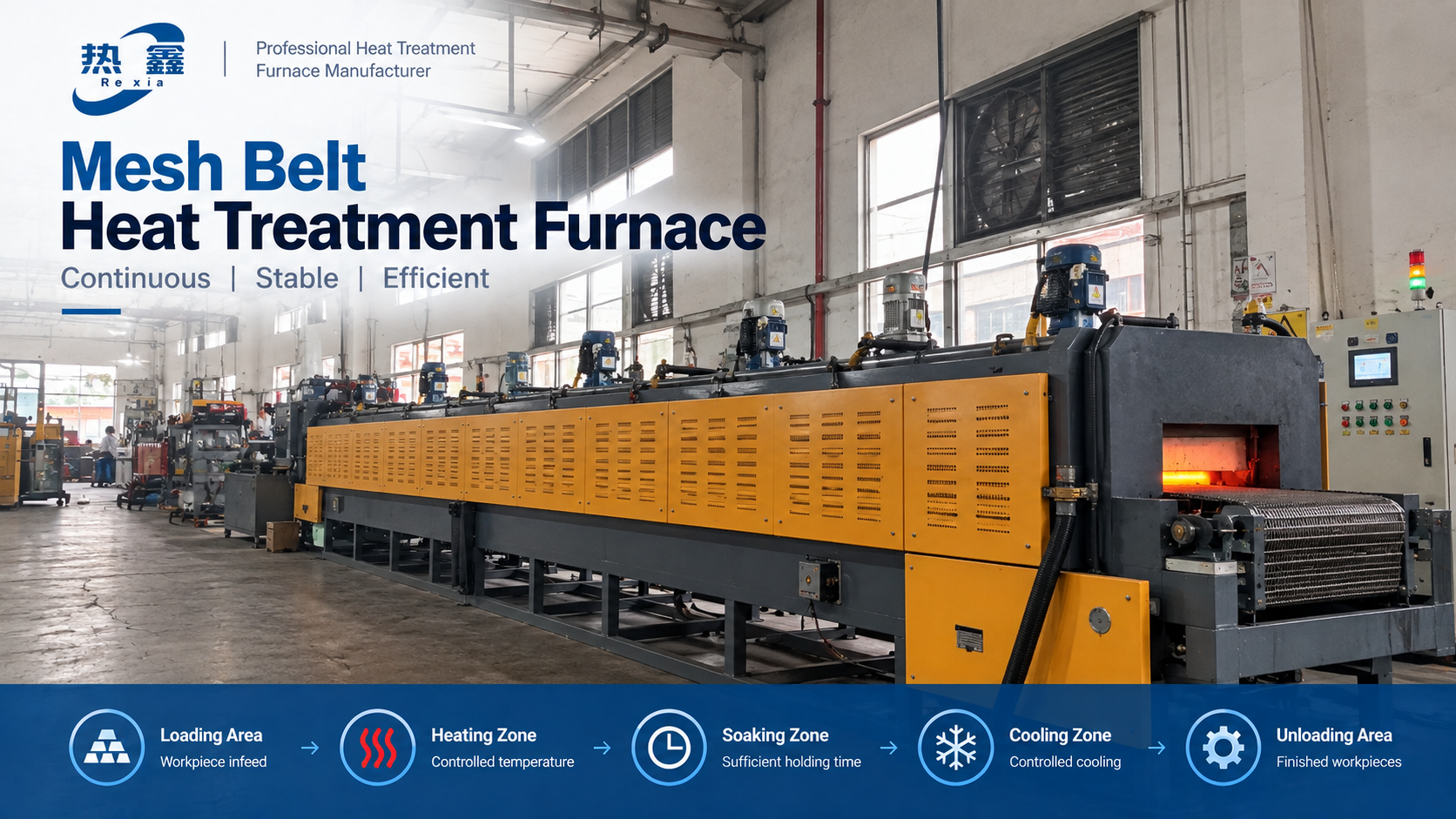 Mesh belt heat treatment furnace with continuous loading, heating, soaking, cooling and unloading process.
A mesh belt furnace is mainly suitable for continuous heat treatment of small and medium-sized parts with relatively stable production volumes.
Typical applications include fasteners, powder metallurgy parts, bearings, automotive components, and small hardware.
When selecting a mesh belt furnace, buyers should not look only at belt width. Important factors also include:
A wider belt does not automatically mean higher useful production capacity. The final throughput depends on the complete thermal process and loading conditions.
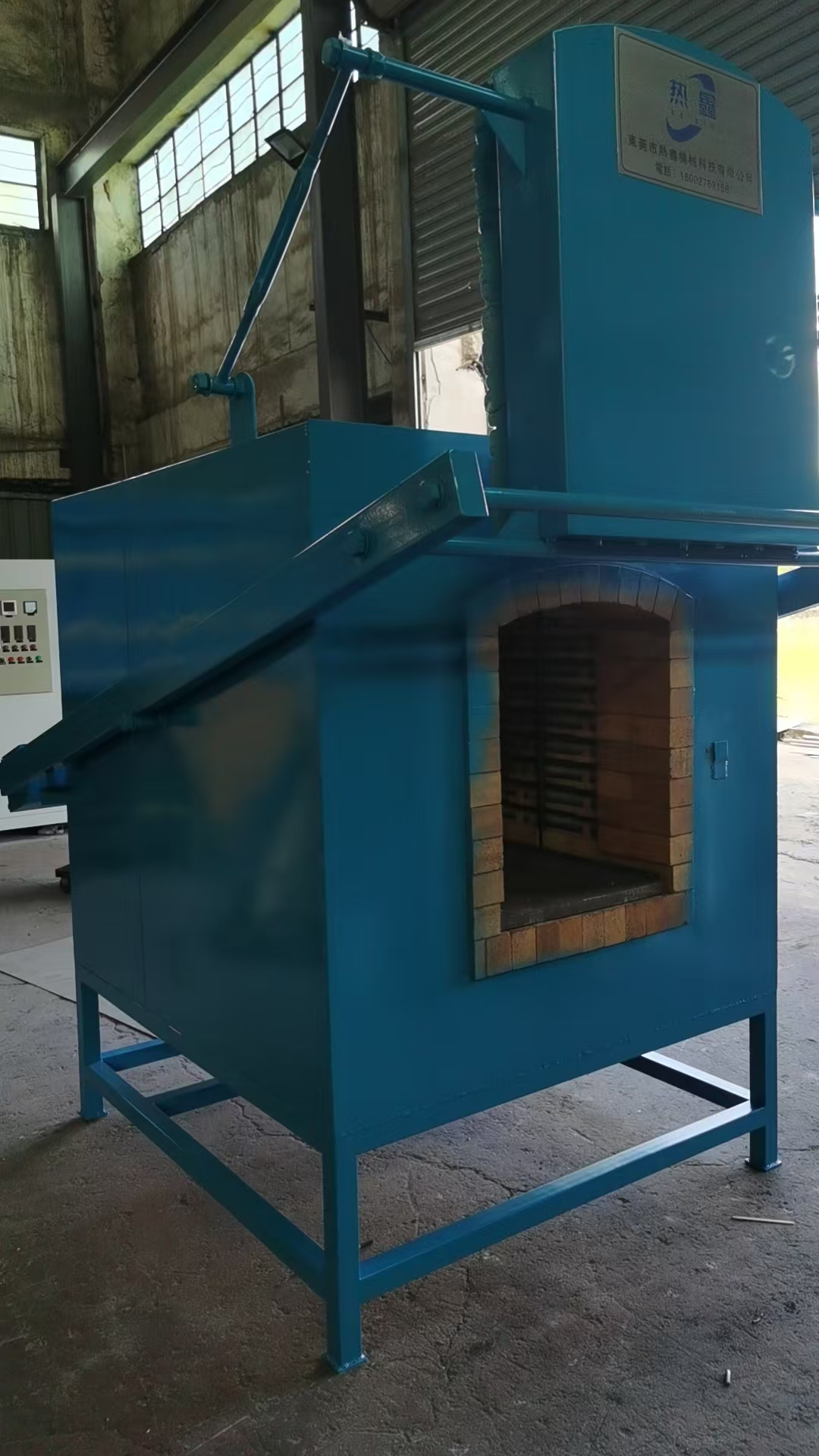
Rexin box-type quenching furnace for batch heat treatment and quenching applications.
A box furnace is a batch-type furnace suitable for manufacturers that require production flexibility, multiple heat treatment recipes, or different workpiece sizes.
It is commonly used for tools, molds, gears, shafts, mechanical parts, and small-to-medium batch production.
Compared with a continuous furnace, a box furnace normally provides greater flexibility but lower continuous throughput.
Key selection factors include chamber size, maximum load weight, temperature uniformity, atmosphere requirements, heating power, loading method, and cooling process.
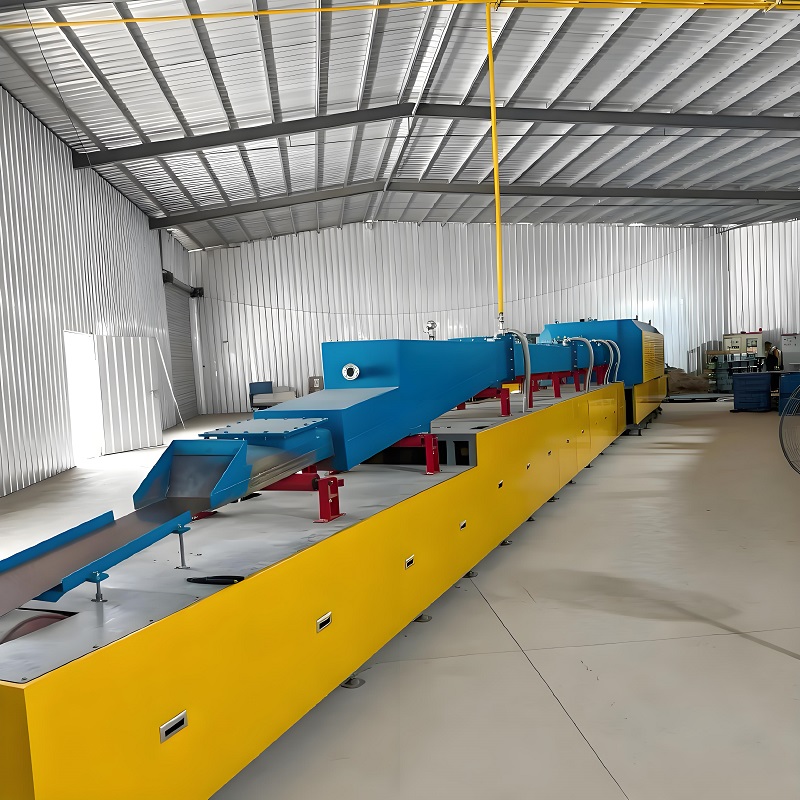
A continuous furnace is generally suitable for high-volume production where similar parts are processed repeatedly.
Typical users include automotive component manufacturers, fastener plants, powder metallurgy factories, bearing manufacturers, and other mass-production facilities.
Compared with batch equipment, a continuous furnace can reduce manual handling and improve production consistency. However, the furnace must be correctly designed around actual throughput requirements.
Important engineering factors include:
For this reason, production capacity should be calculated from the actual workpiece rather than estimated only from furnace dimensions.
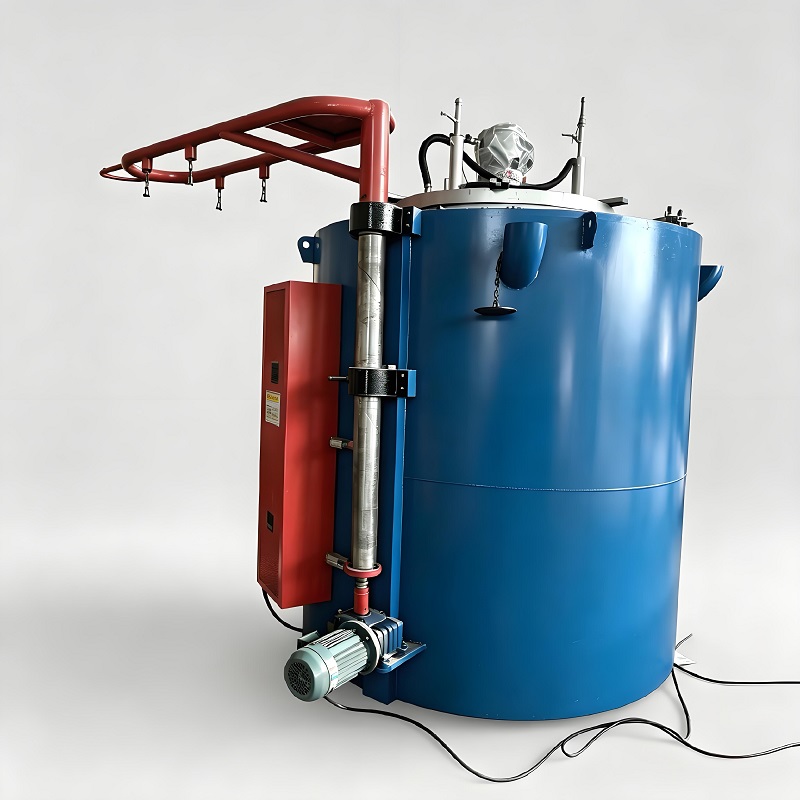
A pit furnace is a vertical batch furnace commonly used for long or vertically loaded components.
Typical applications include:
The vertical structure can help reduce horizontal floor-space requirements and can be suitable for workpieces that are difficult to load into a conventional horizontal chamber.
Important selection factors include furnace depth, loading weight, temperature uniformity, lifting method, atmosphere requirements, and workpiece distortion control.
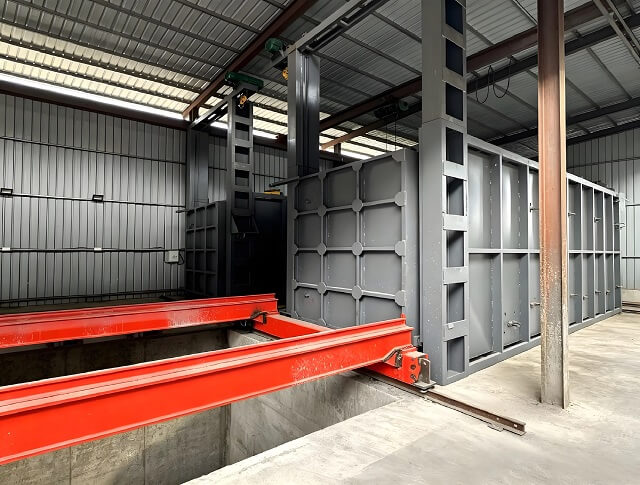
A trolley furnace, also called a car-bottom furnace, uses a movable loading platform to carry large or heavy workpieces into and out of the heating chamber.
It is commonly used for:
Key engineering considerations include loading weight, trolley structure, chamber dimensions, heating uniformity, sealing, insulation, and loading efficiency.
For large workpieces, furnace design should also consider how the component is supported during heating to reduce unnecessary deformation.
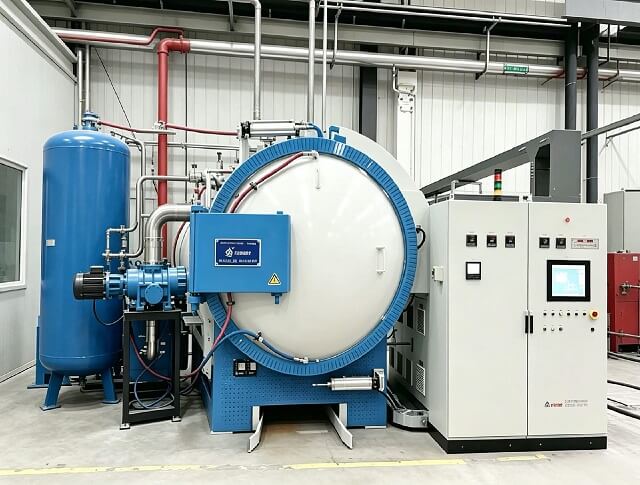
A vacuum furnace performs heat treatment in a low-pressure environment to reduce oxidation, contamination, and unwanted surface reactions.
Typical applications include:
Important selection factors include vacuum level, pumping system, temperature range, cooling method, chamber size, loading capacity, and process requirements.
Vacuum furnaces generally involve higher equipment complexity and investment, so they are most suitable where the product quality or process requirement justifies the additional cost.
The correct furnace type depends on the workpiece material, heat treatment process, production volume, atmosphere requirements, and final quality specifications.
The following table provides a general starting point for common industrial applications. Final furnace selection should be confirmed according to the actual workpiece and production requirements.
| Workpiece | Common Process | Typical Furnace Solution |
|---|---|---|
| Fasteners | Carburizing, Quenching, Tempering | Continuous Mesh Belt Furnace |
| Powder Metallurgy Gears | Sintering | Continuous Sintering Furnace |
| Stainless Steel Tubes | Bright Annealing | Bright Annealing Furnace |
| Automotive Gears | Carburizing, Hardening | Carburizing & Quenching Furnace |
| Bearings | Hardening, Tempering | Batch or Continuous Furnace |
| Aluminum Radiators | Brazing | Controlled Atmosphere Brazing Furnace |
| Aluminum Alloy Parts | Solution Treatment | Solution Heat Treatment Furnace |
| Tools & Dies | Hardening, Tempering | Box or Vacuum Furnace |
This table should be used as an initial reference rather than a final equipment specification. For example, two manufacturers producing similar gears may require different furnace configurations because of differences in material grade, part dimensions, required case depth, production capacity, atmosphere, and quality standards.
When comparing industrial heat treatment furnaces, buyers should not evaluate equipment only by maximum temperature, furnace dimensions, or purchase price.
A technically suitable furnace should be evaluated according to the actual process, workpiece, required production capacity, atmosphere, cooling method, and final quality requirements.
The following specifications are particularly important when comparing furnace solutions.
The furnace must be capable of operating reliably at the required process temperature.
However, a higher maximum temperature does not automatically mean a better furnace. Buyers should distinguish between maximum design temperature, recommended continuous operating temperature, and the actual temperature required by the process.
The more important question is whether the furnace can maintain stable conditions at the required production temperature over long-term operation.
Poor temperature uniformity can contribute to:
When comparing supplier specifications, buyers should ask how temperature uniformity is measured and under what furnace conditions the stated value applies.
A temperature uniformity value should not be evaluated independently from furnace type, working temperature, effective working zone, loading condition, and test method.
Production capacity may be expressed as kg/hour, pieces/hour, tons/day, or batches/day.
Capacity should be calculated according to factors such as:
Buyers should be cautious when comparing only nominal kg/hour figures. Two furnaces with similar external dimensions may provide different useful production capacities depending on the actual workpiece and process
Depending on the furnace type, important dimensions may include chamber width, height and depth, mesh belt width, effective heating-zone length, muffle dimensions, or maximum loading height.
The working dimensions should match the actual workpiece and loading arrangement rather than simply being made as large as possible.
Oversizing a furnace can increase equipment investment, heating demand, atmosphere consumption, and operating cost without necessarily improving useful production capacity.
The required furnace atmosphere depends on the workpiece material, heat treatment process, and required surface or metallurgical properties.
Depending on the application, furnace systems may use nitrogen, hydrogen-containing mixtures, ammonia cracked gas, endothermic atmosphere, inert gas, controlled process atmospheres, or vacuum.
Buyers should evaluate not only which atmosphere is required, but also gas consumption, furnace sealing, atmosphere monitoring, pressure control, safety requirements, and long-term operating cost.
Cooling is an integral part of the heat treatment process and should not be evaluated separately from the heating furnace.
Depending on the application, cooling may involve furnace cooling, controlled gas cooling, air cooling, rapid cooling, oil quenching, water quenching, or other process-specific systems.
The required cooling capacity depends on workpiece material, loading quantity, required cooling rate, final mechanical properties, and distortion requirements.
For industrial production, furnace automation can influence process consistency, operator workload, traceability, and production efficiency.
Depending on the project, control functions may include:
The required automation level should be selected according to the production process rather than simply adding as many functions as possible.
One of the most common decisions when planning a heat treatment line is whether to use a continuous furnace or a batch furnace.
There is no single answer that is suitable for every factory. The correct choice depends on production volume, product variety, process stability, workpiece dimensions, automation requirements, available space, and future production plans.
| Factor | Continuous Furnace | Batch Furnace |
|---|---|---|
| Production Volume | Better suited to medium-to-high volume production | Better suited to low-to-medium volume or batch production |
| Product Variety | Best when similar parts are processed repeatedly | More flexible for different products and recipes |
| Automation | Easier to integrate into automated production lines | Usually requires more batch loading and unloading |
| Process Consistency | Well suited to repeatable continuous processing | Good consistency when each batch is properly controlled |
| Production Flow | Continuous material movement | Load → Process → Unload |
| Floor Space | Often requires a longer production line | Usually more compact depending on furnace design |
| Initial Selection Focus | Throughput, belt speed, loading density, line integration | Chamber size, batch weight, cycle time, flexibility |
For example, a fastener manufacturer producing large quantities of similar parts every day may benefit from a continuous mesh belt heat treatment line.
In contrast, a manufacturer processing different molds, tools, shafts, or low-volume components may benefit more from the flexibility of a batch furnace.
The decision should therefore be based on the production model rather than simply assuming that a continuous furnace is more advanced than a batch furnace.
Production capacity is one of the most important inputs when designing an industrial heat treatment furnace.
A customer may initially request “300 kg/hour” or “500 kg/hour,” but this number alone is not enough to determine the furnace dimensions.
Engineers also need to understand:
These factors influence belt width, loading density, heating-zone length, belt speed, number of temperature zones, heating power, atmosphere consumption, and cooling capacity.
Consider two customers who both require a nominal production capacity of 500 kg/hour.
Customer A produces small fasteners that can be distributed relatively evenly on a mesh belt. Customer B produces larger components that require more spacing and a longer thermal cycle.
Although both customers specify the same kg/hour requirement, the appropriate furnace dimensions, belt speed, heating-zone length, and cooling system may be very different.
This is why a reliable furnace quotation should be based on actual workpiece and process information rather than capacity alone.
The cost of an industrial heat treatment furnace can vary significantly because most industrial furnace systems are configured according to the customer’s process and production requirements.
Instead of asking only “How much does a heat treatment furnace cost?”, buyers should first understand which technical factors influence the final quotation.
A small batch furnace, continuous mesh belt furnace, controlled-atmosphere sintering line, brazing furnace, carburizing line, and vacuum furnace have very different structures and system requirements.
Larger working dimensions and higher production capacity generally require more heating power, structural materials, insulation, conveying capacity, cooling capacity, and supporting equipment.
Higher operating temperatures may require different heating elements, refractory materials, insulation structures, furnace components, and control strategies.
Controlled-atmosphere processes may require gas supply systems, flow control, atmosphere monitoring, sealing systems, exhaust systems, and additional safety equipment.
Oil quenching, water quenching, controlled cooling, rapid cooling, or other specialized cooling systems can significantly affect the overall furnace-line configuration.
PLC systems, HMI controls, recipe management, data recording, automatic loading and unloading, remote monitoring, and production-line integration can also influence equipment cost.
For this reason, comparing furnace quotations only by price can be misleading. Buyers should compare the complete technical scope, furnace materials, process capability, automation, atmosphere system, cooling system, included accessories, installation requirements, and after-sales support.
To recommend a suitable furnace configuration and prepare an accurate quotation, the furnace supplier needs more information than the required maximum temperature.
Providing detailed workpiece and process information at the beginning of a project can reduce unnecessary communication and help engineers evaluate the furnace size, heating system, atmosphere, cooling method, production capacity, and automation requirements more accurately.
Please provide:
Please specify the required process, such as annealing, hardening, tempering, carburizing, sintering, brazing, or solution heat treatment.
If you already have an existing heat treatment process, providing the temperature curve or process parameters can help engineers understand your requirements more accurately.
Please provide the required production capacity in kg/hour, pieces/hour, tons/day, or batches/day.
If possible, also provide the expected working hours per day and production days per year.
Depending on the application, useful information may include:
If known, specify the required protective or process atmosphere. If you are unsure, provide the material and process requirements so that the appropriate atmosphere system can be evaluated.
Useful factory information includes:
It is normal for buyers—especially when planning a new heat treatment line—not to have every technical parameter confirmed at the beginning.
Start with the information you already have: the workpiece, material, current process, target production capacity, and the quality result you need to achieve.
The remaining furnace configuration can then be evaluated step by step according to the actual production requirements.
Every heat treatment project starts with the workpiece, material, process and required production capacity.
If you are planning a new heat treatment line, increasing production capacity, replacing an existing furnace, or trying to solve problems such as oxidation, inconsistent hardness, deformation, unstable atmosphere control or low production efficiency, send us your application requirements.
Rexin can evaluate the workpiece, heat treatment process, production capacity, furnace atmosphere, cooling requirements and factory conditions to help determine a suitable furnace configuration.
For a more accurate furnace recommendation and quotation, please send us:
Have a furnace project? Send us your workpiece drawing or production requirements to discuss the appropriate heat treatment solution.
If you’re interested in our heat treatment furnaces or customized solutions, contact us for professional support and tailored quotations. We look forward to long-term win-win cooperation.