Products
About Us

Technical Support

>
Products>
Furnace Accessories>
Thermocouple>
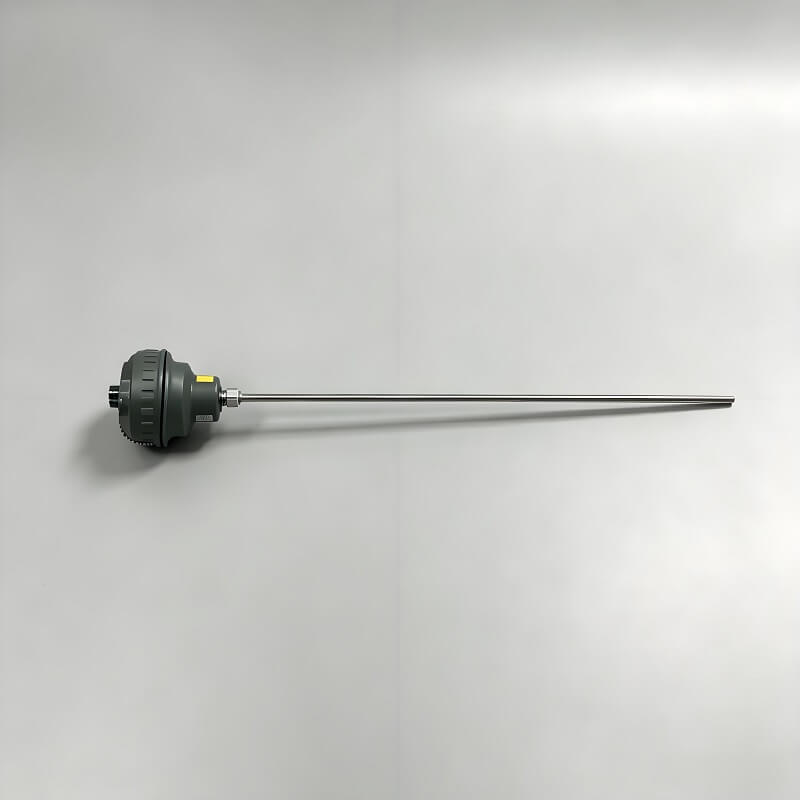
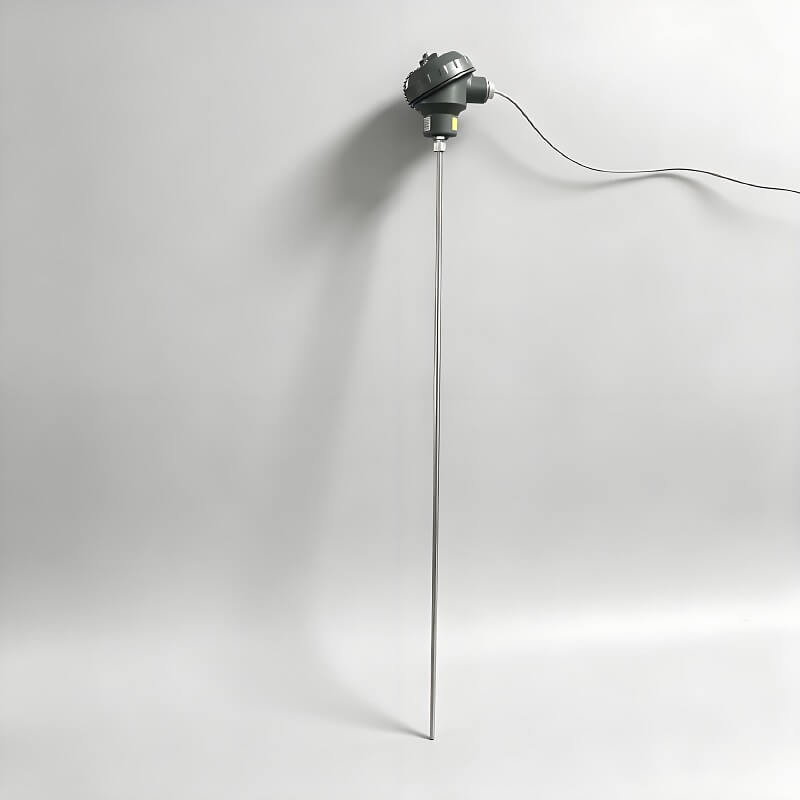
Factory Supply Industrial Thermocouple Temperature Sensor for Heat Treatment Furnace

Industrial thermocouple sensor K S B E J T type for heat treatment furnace, wide temperature range -200~1800℃, stainless steel & ceramic protection tube, customized probe length and thread.
Factory Price
OEM Service
After sales information
Payment Method
Product Description
A thermocouple is the most commonly used temperature sensor. It utilizes the thermoelectric effect generated by the contact of two dissimilar metal conductors to convert temperature difference into voltage signals for measuring high and medium-low temperatures.
Thermoelectric Effect
Weld one end of two metal wires of different compositions together to form the measuring hot junction, which attaches to the measured object for temperature detection. The other two separate ends serve as the reference cold junction kept at a known normal temperature.
When a temperature difference exists between the hot end and cold end, a weak thermoelectric potential (millivolt-level voltage) will be produced in the circuit. The greater the temperature difference, the higher the voltage.
The temperature meter calculates the actual temperature of the hot end by reading the voltage value.
Main Structure
Thermoelectrodes: Two different alloy wires, the core temperature measuring material
Hot Junction: Welding point of two metals that contacts the measured heat source
Insulating Sleeve: Separates the two electrodes to avoid short circuit
Protection Tube: High temperature resistant, corrosion resistant and wear resistant; materials include stainless steel, corundum ceramic, etc.
Terminal Box: Connects compensation wires and temperature controllers
Common Calibration Types
|
Model |
Material |
Temperature Range |
Features |
|
Type K |
Nickel-Chromium / Nickel-Silicon |
-200~1300℃ |
Economical & universal, most widely used in industry |
|
Type S |
Platinum-Rhodium 10 / Platinum |
0~1600℃ |
High precision, standard high-temperature sensor for laboratories |
|
Type B |
Platinum-Rhodium 30 / Platinum-Rhodium 6 |
300~1800℃ |
Ultra-high temperature resistance, excellent oxidation resistance |
|
Type E |
Nickel-Chromium / Copper-Nickel |
-200~800℃ |
Large thermoelectric output, high sensitivity |
|
Type J |
Iron / Copper-Nickel |
-210~750℃ |
Low cost, prone to oxidation, not for long-term high-temperature use |
|
Type T |
Copper / Copper-Nickel |
-200~350℃ |
Superior accuracy for low temperature measurement |
Advantages & Disadvantages
Advantages
Extremely wide measuring range: available from -200℃ up to 1800℃
High temperature resistance, applicable for furnaces, heat treatment furnaces, boilers and industrial heating equipment
Simple structure and fast thermal response; can be made into thin probes for narrow-space measurement
Low cost, suitable for mass industrial temperature measurement
Supports long-distance signal transmission, matches temperature controllers for automatic temperature control
Disadvantages
Tiny output voltage, susceptible to electromagnetic interference
Ambient temperature fluctuation at cold junction causes measurement error, cold junction compensation is required
Lower low-temperature accuracy compared with PT100 thermal resistance
Typical Application Scenarios
High-temperature measurement for industrial heat treatment furnaces (mesh belt furnaces, vacuum furnaces, annealing furnaces), kilns, injection molding machines, boilers, aluminum melting furnaces, drying ovens, power pipelines, metallurgical equipment, auto parts thermal processing equipment and more.
Difference Between Thermocouple and PT100
Thermocouple: For high temperature measurement, outputs voltage signals, types K/S/B/E/J/T
PT100 Thermal Resistance: For normal & low temperature (-200~600℃), works on resistance variation with higher measurement accuracy
Thermocouple
If you’re interested in our heat treatment furnaces or customized solutions, contact us for professional support and tailored quotations. We look forward to long-term win-win cooperation.