Products
About Us

Technical Support

Jul. 23, 2026
Share:
1. Overview of Sintering
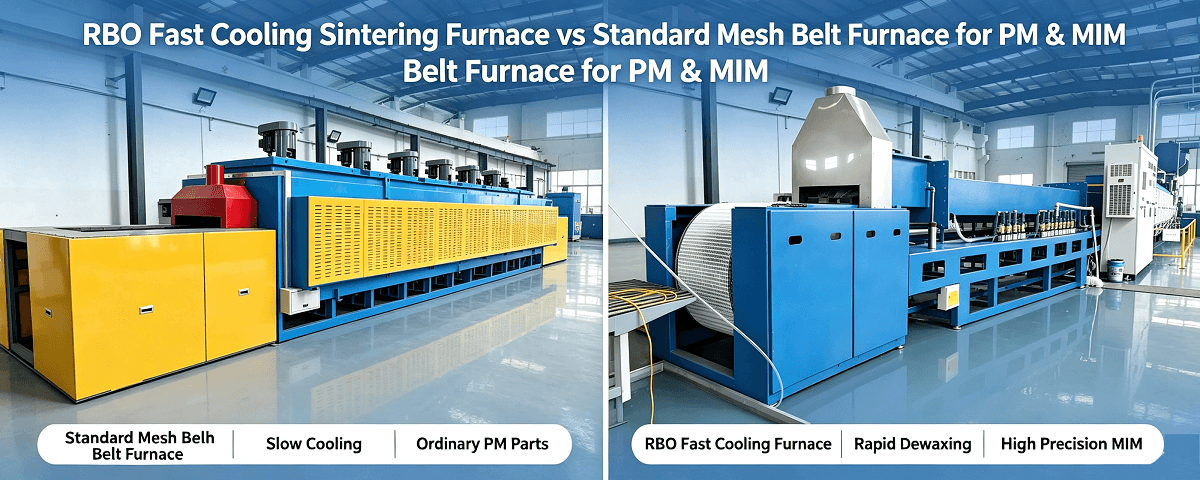
Sintering is the most critical process in powder metallurgy (PM) and MIM manufacturing, directly determining workpiece dimensional stability, surface quality, mechanical properties and mass production yield. For decades, standard mesh belt sintering furnaces have served basic ferrous component production, while the upgraded RBO (Rapid Burn-Off) fast dewaxing and fast cooling integrated sintering furnace has become the mainstream equipment for high-precision, high-standard stainless steel and automotive PM parts.
Many manufacturers struggle with equipment selection, confused by differences in dewaxing efficiency, cooling performance, production capacity, operational cost and applicable scenarios. This article provides a full, professional comparison of structural design, processing technology, energy consumption, maintenance cost, technical parameters and real overseas project cases to help you select the most suitable sintering furnace for long-term stable production.
2. Core Technical Definition
2.1 RBO (Rapid Burn-Off) Rapid Dewaxing A dedicated high-temperature combustion dewaxing section independently designed for PM green compacts. It rapidly decomposes and burns out internal lubricants including paraffin and zinc stearate through forced high-temperature circulation. This mechanism greatly improves dewaxing speed and achieves thorough wax removal without residual carbon accumulation.
2.2 Forced Fast Cooling Technology Equipped with water-jacket cooling structure and circulating protective atmosphere cooling system. The cooling rate reaches ≥2℃/s, which quickly skips the dangerous temperature range of 850℃~500℃. It effectively avoids material embrittlement, carbon precipitation and intergranular corrosion, stabilizing the mechanical performance and surface brightness of sintered parts.
3. Core Structural Differences
3.1 Dewaxing System Difference
Standard Mesh Belt Furnace: Adopts a simple low-temperature preheating dewaxing zone relying on slow natural heating and gradual lubricant volatilization. The slow dewaxing speed causes wax vapor to accumulate inside the furnace, easily leading to carbon residue, workpiece bubbling, blistering and cracking defects during mass production.
RBO Integrated Sintering Furnace: Configured with an independent dual-zone gas-fired direct-burning RBO dewaxing system. Equipped with high-temperature radiation tubes and directional airflow purging, it instantly exhausts wax vapor through negative pressure drainage. The one-time thorough dewaxing completely eliminates residual carbon and solves traditional dewaxing defects from the source.
3.2 Cooling System Difference
Standard Mesh Belt Furnace: Uses natural slow cooling and simple open air cooling with a low cooling rate of only 0.3~0.8℃/s. Workpieces stay in the high-temperature oxidation zone for an extended period. Long-time high-temperature retention easily causes surface rusting on stainless steel parts and uneven, unstable hardness on ferrous parts.
RBO Fast Cooling Furnace: Features an independent fully sealed water-jacket cooling chamber with nitrogen circulating forced heat exchange. The ultra-fast cooling speed rapidly crosses the critical brittle temperature zone, restrains intergranular precipitation and oxidation, improves surface anti-rust performance and greatly enhances the consistency of mechanical properties.
3.3 Furnace Chamber Structural Difference
Standard Mesh Belt Furnace: Traditional muffle tube structure is adopted. Dewax residue adheres firmly to the inner wall of the muffle tube, resulting in difficult daily cleaning, frequent contamination and high long-term maintenance pressure.
RBO Fast Cooling Furnace: Advanced muffle-free integrated hearth design. Dewax sediment automatically settles to the furnace bottom for easy cleaning and daily maintenance. The optimized structure supports 24-hour uninterrupted large-scale continuous production and extends furnace service life.
4. Process, Capacity & Quality Performance Comparison
4.1 Production Cycle & Capacity
The RBO integrated sintering furnace optimizes the overall production process, shortening the full-line production cycle by 20%–35% and increasing single-machine production capacity by more than 30%. In contrast, standard mesh belt furnaces are limited by slow belt speed and inefficient dewaxing & cooling process, resulting in low single-shift output and unable to support high-volume order delivery.
4.2 Finished Product Quality
RBO Furnace Output: Zero carbon residue, excellent dimensional stability and uniform hardness distribution. Stainless steel parts avoid intergranular corrosion and surface oxidation. For most standard precision parts, secondary quenching treatment can be omitted, simplifying the production process and reducing production costs.
Standard Furnace Output: Incomplete dewaxing easily causes bubbling, blistering, carburization and decarburization. Stainless steel workpieces are prone to rust and discoloration after sintering. Secondary heat treatment is mandatory to repair defective properties, increasing rework rate and labor costs.
4.3 Applicable Production Range
Standard Mesh Belt Furnace: Suitable for low-precision ferrous structural parts, low-density oil-impregnated bushings and small-batch ordinary powder metallurgy production with loose quality requirements.
RBO Fast Dewaxing & Fast Cooling Furnace: Specially designed for high-end precision production, including stainless steel PM components, high-precision transmission gears, MIM injection molding parts, high-density ferrous parts, compressor accessories and automotive precision mechanical parts.
4.4 Energy Consumption & Operation & Maintenance Cost
RBO Furnace: Adopts intelligent zoning temperature control system, with lower energy consumption per unit product. Although the initial procurement cost and floor space are larger, it features high automation, stable operation and fewer consumable replacements, effectively reducing long-term comprehensive production costs.
Standard Furnace: Low initial equipment cost and simple daily operation. However, its outdated process leads to high defective rate, frequent rework and continuous consumable loss, resulting in higher hidden operation costs for long-term mass production.
5. Equipment Overview & Full Technical Parameters
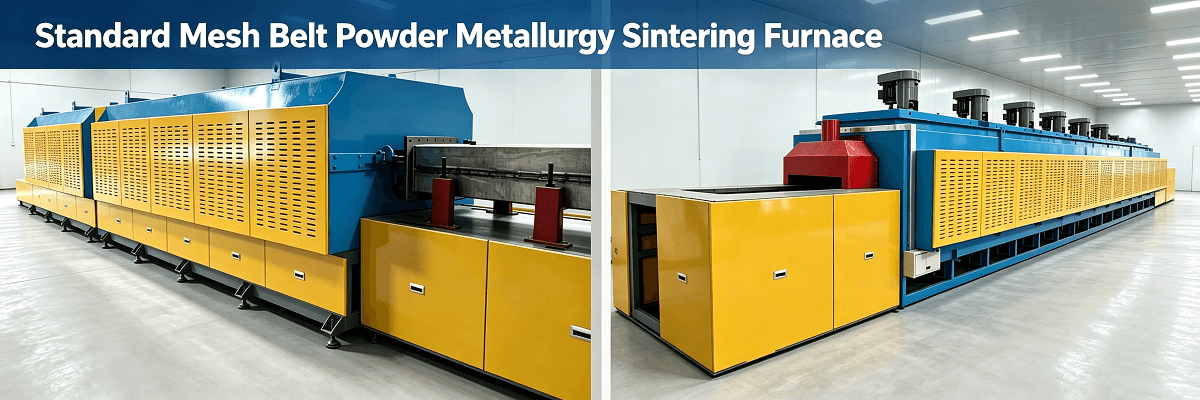
5.1 Standard Continuous Mesh Belt Sintering Furnace
Equipment Introduction
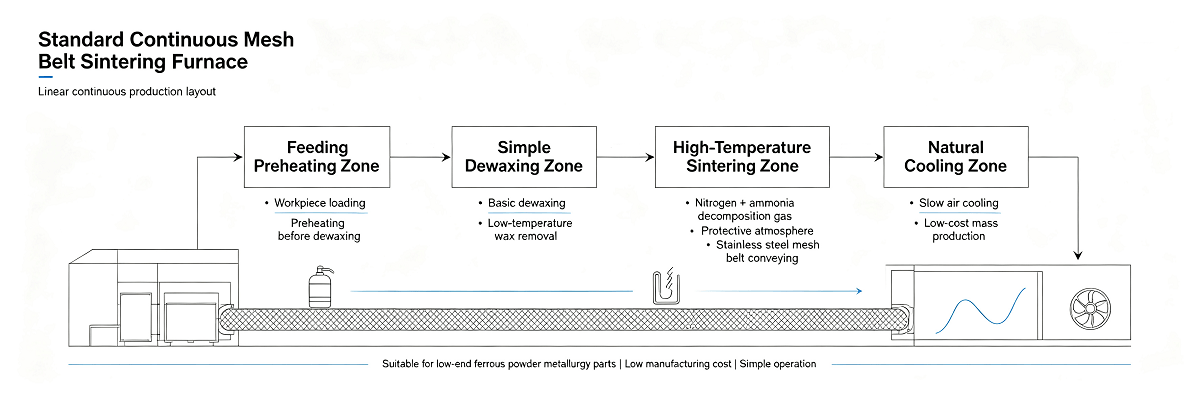
The standard continuous mesh belt sintering furnace adopts linear continuous production layout: feeding preheating zone → simple dewaxing zone → high-temperature sintering zone → natural cooling zone. It transports workpieces continuously via stainless steel mesh belt and adopts nitrogen + ammonia decomposition gas as protective atmosphere. It only completes basic dewaxing and slow air cooling processes, targeting low-end ferrous powder metallurgy parts mass production. It is widely recognized for low manufacturing cost and simple operation.
Mesh Belt Sintering Furnace Process Diagram
Advantages & Disadvantages
Pros: Low equipment investment, simple operation and maintenance, compact floor space, stable for ordinary low-standard production.
Cons: Incomplete dewaxing, slow cooling speed, easy carbon residue and rust defects, low production capacity, unable to meet precision and anti-oxidation requirements for stainless steel and high-precision components.
5.2 RBO Rapid Dewaxing & Fast Cooling Integrated Sintering Furnace
Equipment Introduction
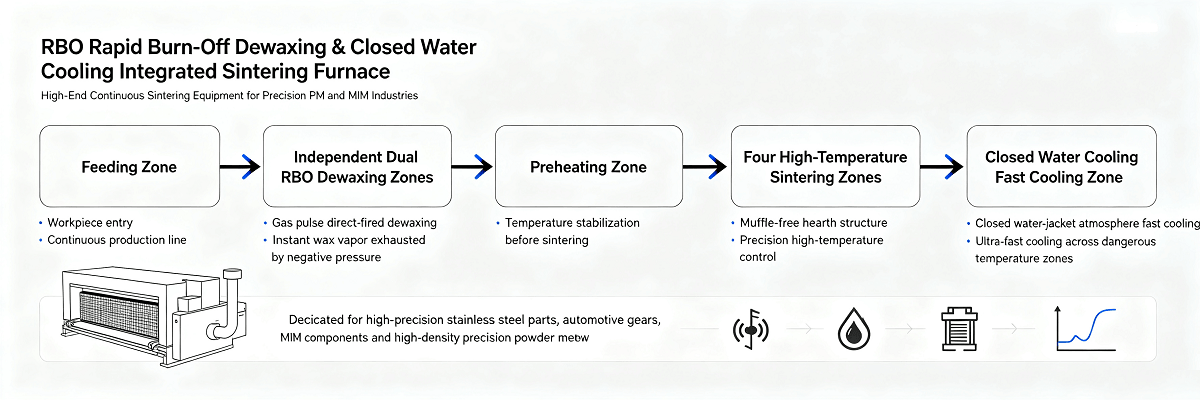
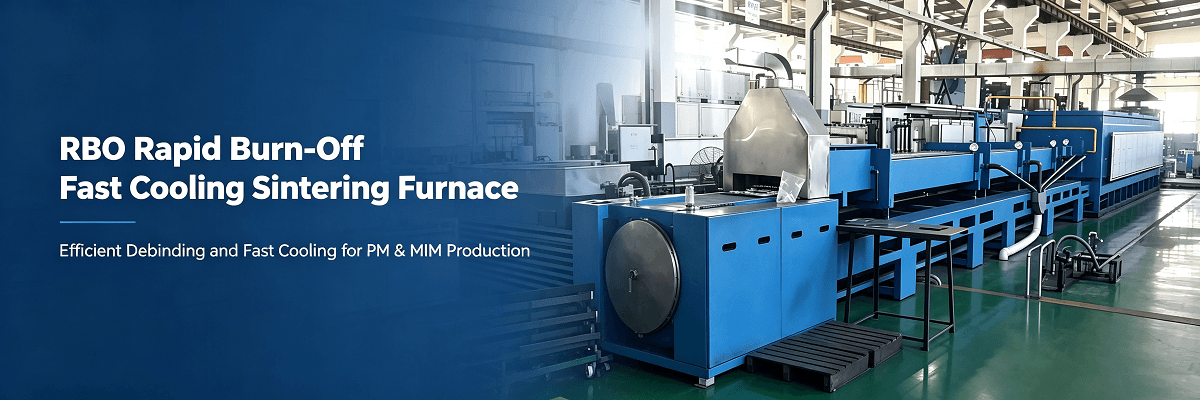
The RBO rapid burn-off dewaxing & closed water cooling integrated sintering furnace is an upgraded high-end continuous sintering equipment for precision PM and MIM industries. The full production line is divided into feeding zone → independent dual RBO dewaxing zones → preheating zone → four high-temperature sintering zones → closed water cooling fast cooling zone.
With muffle-free hearth structure and gas pulse direct-fired dewaxing technology, wax vapor is exhausted instantly through negative pressure suction. The matched closed water-jacket atmosphere fast cooling system realizes ultra-fast cooling across dangerous temperature zones. It is the professional dedicated equipment for high-precision stainless steel parts, automotive gears, MIM components and high-density precision powder metallurgy products.
RBO Integrated Sintering Furnace Process Diagram
Core Advantages
Thorough RBO Rapid Dewaxing: Eliminate bubbling and carbon residue defects, stabilize dimensional accuracy and greatly reduce product rejection rate.
Professional Forced Fast Cooling: Bypass 850℃~500℃ intergranular corrosion temperature range, ensure stainless steel parts rust-free and ferrous parts with uniform and stable hardness.
Muffle-Free Hearth Design: Automatic sedimentation of dewax residue, convenient cleaning and maintenance, longer furnace service life.
High Automation & High Yield: Support long-term 24-hour continuous mass production of high-precision powder metallurgy components.
6. Full Technical Parameter Comparison Table
|
Technical Item |
Standard Mesh Belt Sintering Furnace |
RBO Fast Cooling Integrated Sintering Furnace |
| Overall Dimension (L×W×H) | 21500×2000×1900mm | 24600×2280×2020mm |
|
Mesh Belt Specification |
SUS314 Heat-Resistant Stainless Steel, 610mm Width |
SUS314 Heat-Resistant Stainless Steel, 610mm Width |
|
Effective Furnace Height |
120mm |
125mm |
|
Temperature Zones Configuration |
2 Preheating Zones + 4 Sintering Zones (6 Independent Zones) |
2 RBO Dewaxing Zones + 1 Preheating Zone + 4 Sintering Zones + 1 Fast Cooling Zone (8 Independent Zones) |
|
Max Working Temperature |
1150℃ (Regular ferrous sintering: 1120℃) |
Max Sintering: 1150℃; Max RBO Dewaxing: 950℃ |
|
Temperature Uniformity |
±5℃ |
±4℃ |
|
Total Heating Power |
260kW (Resistance Wire Heating) |
320kW (Gas Pulse Combustion for Dewaxing + SiC Electric Heating for Sintering) |
|
Cooling Method & Rate |
Natural Air Cooling, 0.3~0.8℃/s |
Sealed Water-Jacket + Nitrogen Forced Circulation Cooling, ≥2℃/s |
|
Protective Atmosphere System |
N₂ + Ammonia Decomposition, Simple Exhaust Pipeline |
High-Purity N₂ + Ammonia Decomposition, Automatic Carbon Potential Compensation System |
|
Belt Running Speed |
0.2~0.8m/min Adjustable |
0.3~1.0m/min Frequency Conversion Adjustable |
|
Control System |
PLC + Touch Screen, Single-Segment PID Control, No Carbon Potential Compensation |
Siemens PLC + 15-inch Touch Screen, Full Automatic Interlock, Multi-Safety Alarm (Over-Temp, Atmosphere, Cooling Water) |
|
Single-Shift (8h) Production Capacity |
1.8~2.5 Tons (Ferrous Parts) |
3.2~4 Tons, 35% Higher Than Standard Furnace |
|
Applicable Materials & Products |
Low-density ferrous & copper-based ordinary powder parts, common structural bushings |
Stainless steel PM parts, MIM components, high-density ferrous gears, compressor & automotive precision parts, high-end copper-based parts |
7. Real Overseas Project Case Studies
Case 1: Thailand Stainless Steel MIM Factory Upgrade Project
An export-oriented Thai MIM precision hardware factory focused on stainless steel electronic and medical components. The factory originally adopted standard mesh belt sintering furnaces but faced persistent quality and capacity bottlenecks. Incomplete natural dewaxing caused carbon spots and bubbling defects, while slow natural cooling led to stainless steel oxidation and discoloration. The 7%–9% defective rate and additional manual polishing process severely restricted order delivery capacity.
Production Improvement After RBO Furnace Upgrade
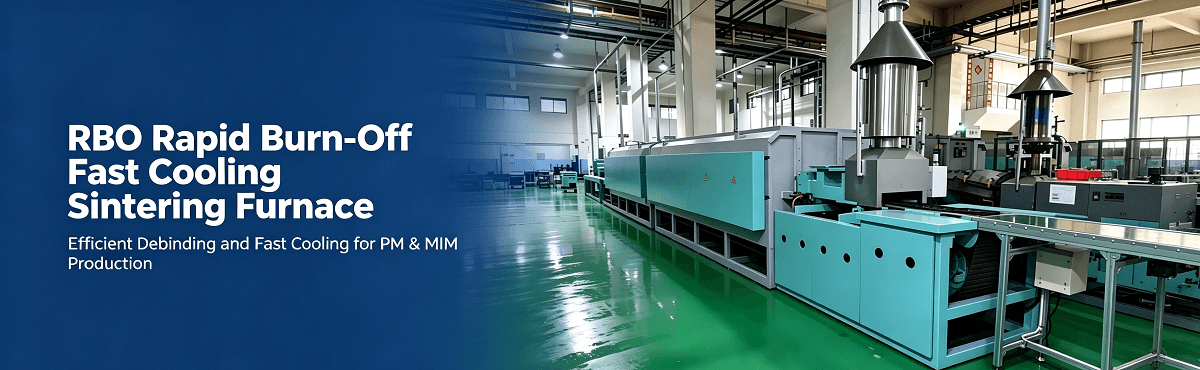
After replacing with ReXin RBO fast dewaxing and fast cooling integrated sintering furnace, the independent gas-fired RBO dewaxing system completely solved residual carbon defects. The sealed forced fast cooling system eliminated stainless steel oxidation thoroughly. The final product reject rate dropped below 1.8%, the secondary polishing process was completely removed, and single-shift production capacity increased by 36%, fully meeting high-standard export order requirements.
Case 2: Vietnam Automotive Precision Gear Production Project
A Vietnamese automotive component manufacturer specializes in high-density ferrous transmission gears for vehicle assembly. Using traditional standard sintering furnaces, the low cooling rate caused scattered hardness values and unstable dimensional tolerance. Unqualified consistency led to frequent assembly failure and high rework rates, failing automotive OEM quality standards.
Actual Operation Effect
The RBO furnace’s thorough segmented dewaxing ensures internal purity of high-density gear workpieces without impurity defects. The ultra-fast cooling technology stabilizes material microstructure and mechanical properties. All finished gears achieve uniform hardness and precise dimensional tolerance, fully complying with automotive batch assembly standards and supporting stable 24-hour continuous mass production.
Case 3: Ordinary Ferrous Bushing Mass Production (Standard Furnace Application)
For manufacturers focusing on low-density iron-based oil-impregnated bushings and ordinary structural parts with low precision and surface requirements, standard mesh belt sintering furnaces remain the most cost-effective choice. With low upfront investment, simple operation and basic stable output, it perfectly meets the production demands of low-end conventional powder metallurgy parts without unnecessary cost waste.
>>> Rexin Machiery Factory More Projects
8. Professional Equipment Selection Guide
8.1 Choose Standard Mesh Belt Sintering Furnace If:
You mainly produce ordinary low-density ferrous structural parts and oil-impregnated bushings, with limited equipment budget, small-to-medium batch production volume and low requirements for workpiece precision, surface finish and anti-oxidation performance.
8.2 Choose RBO Fast Dewaxing & Fast Cooling Sintering Furnace If:
Your product line covers stainless steel powder metallurgy parts, MIM injection components, high-precision gears, automotive and compressor precision parts. If you pursue ultra-low defective rate, consistent product quality, large-batch continuous production and long-term stable brand quality competitiveness, the RBO integrated furnace is the mandatory optimal solution.
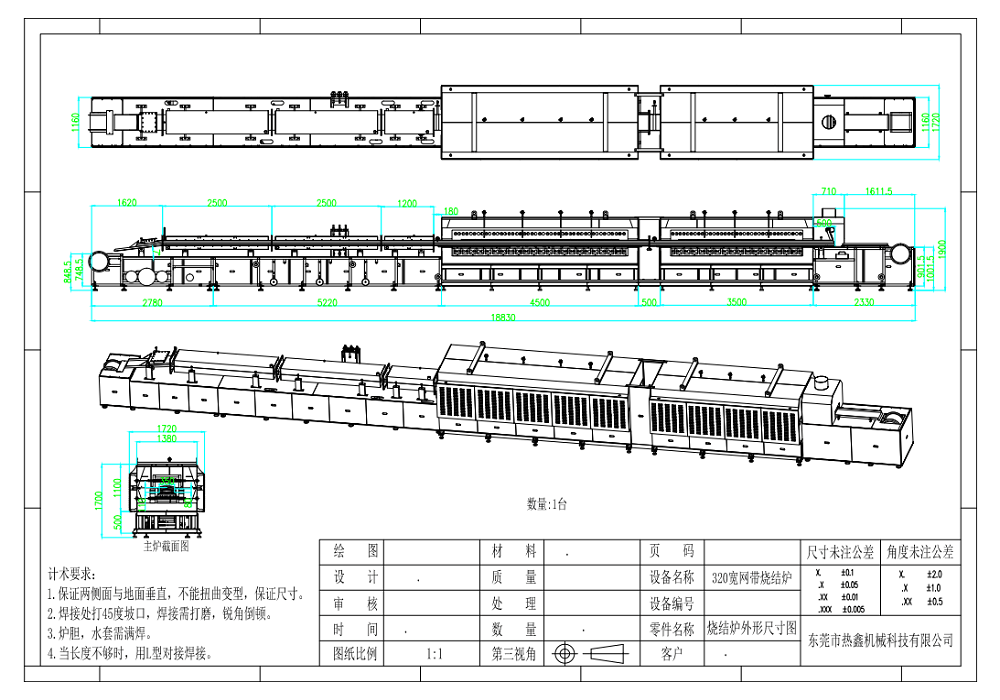
Powder metallurgy sintering furnaces Drawing Design
9. Conclusion
The difference between standard and RBO sintering furnaces lies not only in structural design, but also in fundamental upgrades of dewaxing logic, cooling mechanism, production efficiency and quality control. Standard furnaces adapt to low-budget, low-standard ordinary production, while RBO fast cooling furnaces solve the core pain points of carbon residue, oxidation, unstable hardness and low capacity in precision PM and MIM manufacturing.
ReXin Machinery focuses on customized sintering furnace solutions for global powder metallurgy and MIM manufacturers. We provide professional equipment selection, process optimization and full after-sales service according to your workpiece material, dimensional tolerance, hourly output and workshop layout.
Feel free to send us your production parameters, our engineering team will provide a free customized technical proposal within 24 hours
If you’re interested in our heat treatment furnaces or customized solutions, contact us for professional support and tailored quotations. We look forward to long-term win-win cooperation.