Products
About Us

Technical Support

Jul. 28, 2026
Share:
Furnace brazing is a precise, repeatable metal joining process widely used in automotive thermal systems, refrigeration hardware, new energy equipment, aerospace components and precision machinery manufacturing. As core thermal processing equipment, a brazing furnace (also known as a brazing oven) uniformly heats pre-assembled metal components, melts specialized brazing fillers while preserving base material integrity, and creates high-strength, airtight, corrosion-resistant joints under controlled atmospheric or vacuum conditions.
As an experienced export-oriented brazing furnace manufacturer, we receive frequent global inquiries for vacuum brazing furnaces, custom atmosphere brazing systems and industrial brazing solutions. Most manufacturing buyers face low yield rates, oxidized surfaces, inconsistent quality and high operational costs due to improper furnace selection and mismatched process parameters.
This guide systematically introduces standardized furnace brazing workflows, fully classifies mainstream brazing furnace types, explains working principles and core advantages, and provides data-supported application cases and professional selection criteria. It helps plant managers, purchasing engineers and technical teams select ideal equipment for stainless steel, copper, aluminum and alloy brazing projects.
Furnace brazing delivers standardized, automated and large-scale thermal bonding compared to unstable manual flame brazing. The unified industrial workflow ensures consistent heating time, uniform temperature distribution and repeatable batch quality for precision metal assemblies.
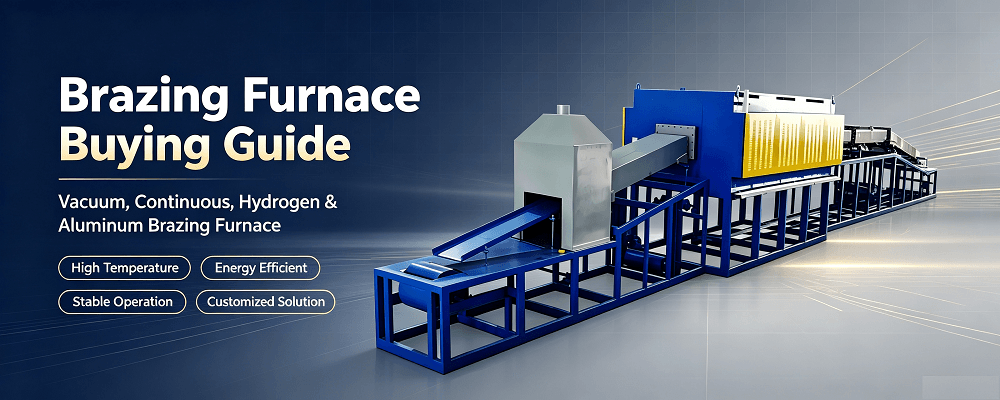
Standard Brazing Workflow:
1. Workpiece pretreatment: Degreasing, derusting and oxide removal to ensure ultra-clean joint surfaces.
2. Assembly and filler placement: Precise installation of solder paste, strips or preforms at component gaps.
3. Standard furnace loading: Neat placement of workpieces to avoid overlapping and heating dead zones.
4. Programmable staged heating: Gradual preheating, constant-temperature brazing and soaking based on material characteristics.
5. Precision controlled cooling: Slow cooling under vacuum or protective atmosphere to prevent cracking and deformation.
6. Post-process inspection: Testing of joint tightness, surface finish and mechanical strength to screen qualified products.
This standardized procedure is highly suitable for stainless steel structural parts, aluminum heat exchangers and precision copper pipeline assemblies, effectively solving quality instability and low efficiency issues caused by traditional manual brazing.
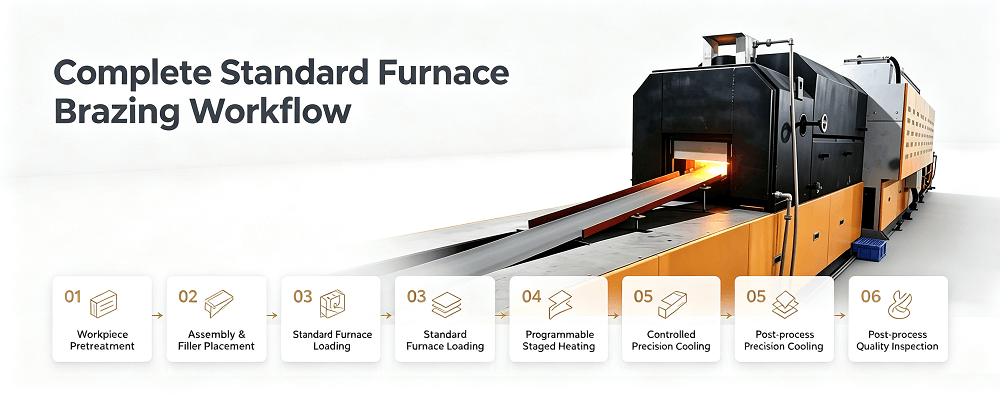
2. Full Classification & Introduction of Industrial Brazing Furnaces
Industrial brazing furnaces are classified by working atmosphere, production mode and structural design. Each type features exclusive working principles, technical strengths and targeted application scenarios, providing reliable basis for equipment selection.
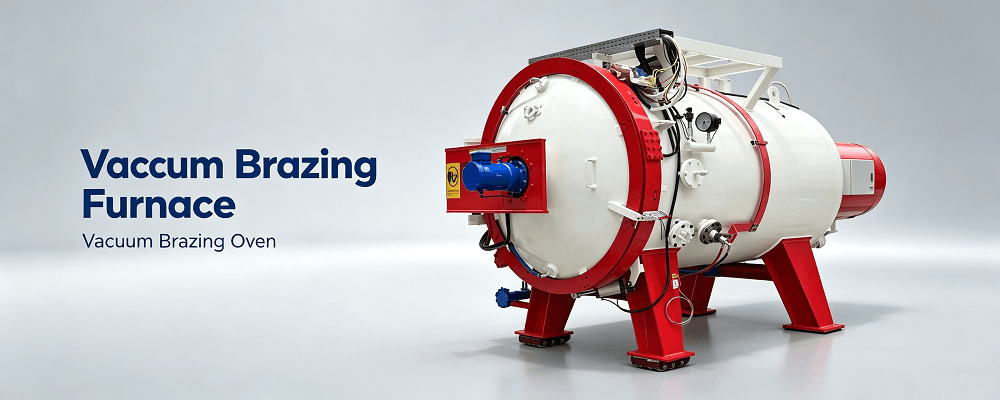
2.1 Vacuum Brazing Furnace / Vacuum Brazing Oven
A vacuum brazing furnace is high-end precision thermal processing equipment operating in a high-vacuum sealed chamber (10⁻² ~ 10⁻³ Pa). It realizes flux-free, high-precision brazing through vacuum degassing and uniform radiant heating, completely eliminating high-temperature oxidation.
Working Principle The furnace removes internal air and moisture to establish a stable vacuum environment. Workpieces are heated gradually to brazing temperature, melting fillers while keeping base metals solid. Molten solder spreads evenly via capillary action, fully fills assembly gaps, and forms dense, high-strength metallurgical joints after precise vacuum cooling.
Core Features Zero oxidation, no solder residue, minimal deformation, ultra-high joint compactness and excellent batch consistency. Ideal for high-airtightness and high-precision industrial components.
Applicable Scenarios Precision stainless steel parts, titanium alloy components, high-pressure cooling plates, hydraulic manifolds and ultra-precision mechanical assemblies.
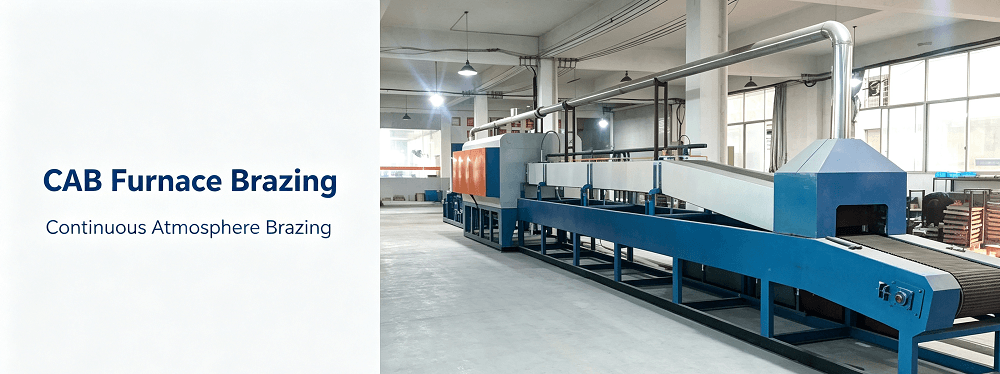
2.2 CAB Controlled Atmosphere Brazing Furnace
CAB (Controlled Atmosphere Brazing) furnaces are mainstream automated mass-production brazing systems using artificially configured protective atmospheres. With stable quality and cost-effective operation, they are widely adopted in standardized industrial brazing production, mainly divided into hydrogen brazing furnaces and aluminum brazing furnaces.
2.2.1 Hydrogen Brazing Furnace
A hydrogen brazing furnace adopts high-purity hydrogen as a reducing protective atmosphere to eliminate surface oxides during heating, producing mirror-bright oxide-free workpiece surfaces without secondary polishing.
Working Principle The sealed chamber replaces air with pure hydrogen to form an oxygen-free reducing environment. High-temperature hydrogen reduces and strips metal surface oxides uniformly. Fillers melt and flow into assembly gaps through capillary action under constant temperature. The entire heating and cooling process is fully isolated from oxygen to guarantee bright, clean and high-strength brazed joints.
Core Advantages & Applications Excellent anti-oxidation performance, consistent bright surface quality and stable joint strength. Widely used for copper pipe fittings, stainless steel fasteners and precision hardware assemblies.
2.2.2 Aluminum Brazing Furnace
Aluminum brazing furnaces are professional customized systems dedicated to aluminum alloy brazing. Equipped with high-purity nitrogen protection and standard Nocolok flux systems, they solve aluminum’s high-temperature oxidation and poor solder wettability challenges.
Working Principle Nitrogen fully isolates external oxygen to prevent secondary oxidation. Uniform flux activation and staged heating remove dense aluminum oxide films. Solder melts evenly and fills gaps stably, forming flawless, high-stability joints for aluminum components.
Applicable Scenarios Automotive radiators, air conditioning evaporators, new energy aluminum heat exchangers and precision heat dissipation parts.
2.3 Continuous Mesh Belt Brazing Furnace
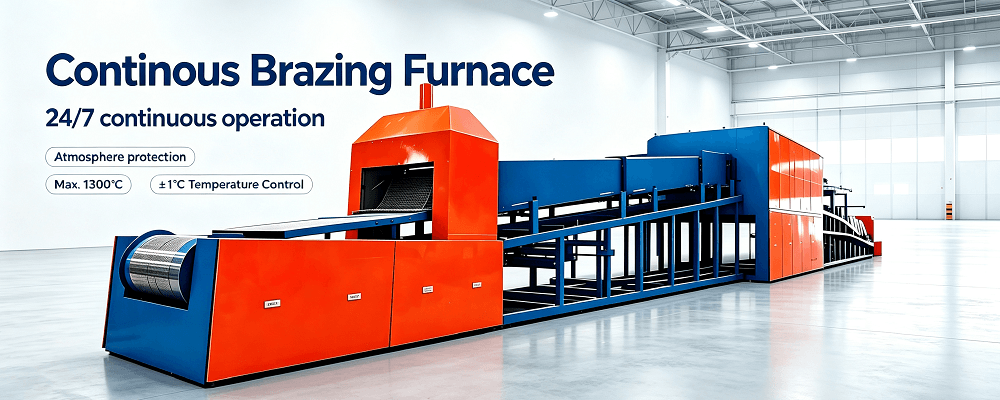
A continuous brazing furnace is a fully automated assembly-line brazing device featuring a mesh belt conveyor structure, supporting 24/7 non-stop mass production. Workpieces pass sequentially through independent preheating, high-temperature brazing and sealed cooling zones for one-pass automatic processing.
Working Principle Different from intermittent batch furnaces, it adopts a linear transmission and fully sealed multi-temperature-zone structure. Custom hydrogen or nitrogen atmosphere systems support continuous automatic brazing. Workpieces move at stepless adjustable speed to complete dehumidification, oxide removal, brazing and staged cooling, ensuring consistent heating duration and uniform batch quality.
Core Advantages 24/7 continuous operation, independent atmosphere protection, max 1300℃ working temperature and ±1℃ high-precision temperature control. The Swedish SUS310S heat-resistant steel muffle and optimized structural design extend service life. High-performance refractory lining reduces energy loss. Complete alarm, anti-flashback and explosion-proof devices ensure operational safety. The first-pass yield reaches 99.5%. It supports precision brazing for complex parts and requires no post-brazing cleaning, allowing direct plating and painting.
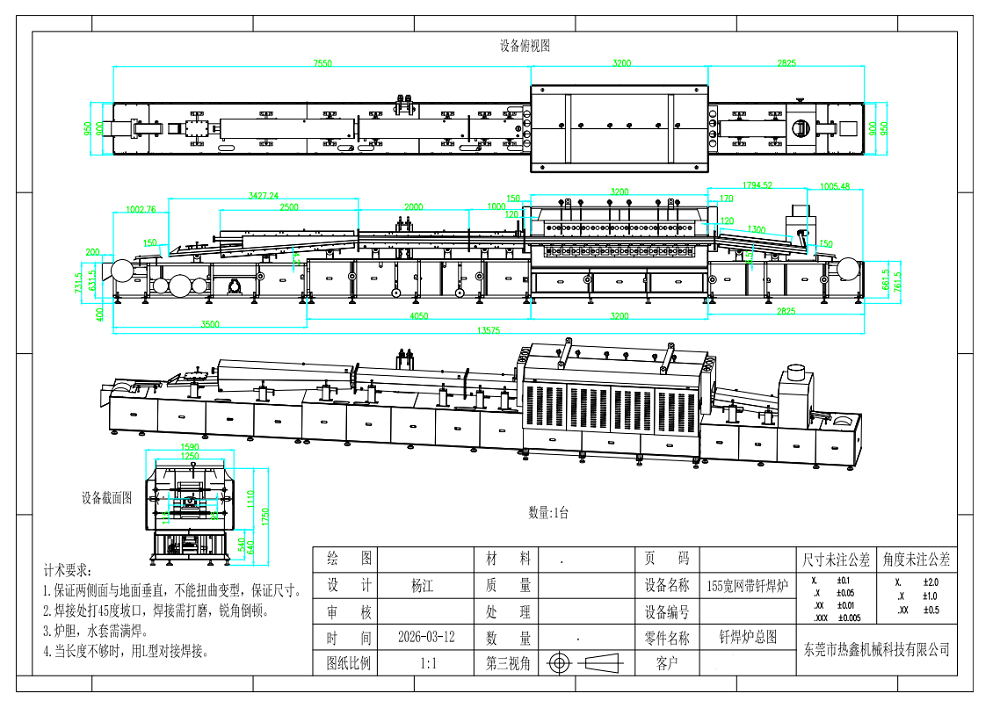
Main Components Preheating Zone, Heating & Soaking Zone, Cooling Zone, Mesh Belt Drive System, Gas Protection System, Water Cooling System, Intelligent Control System
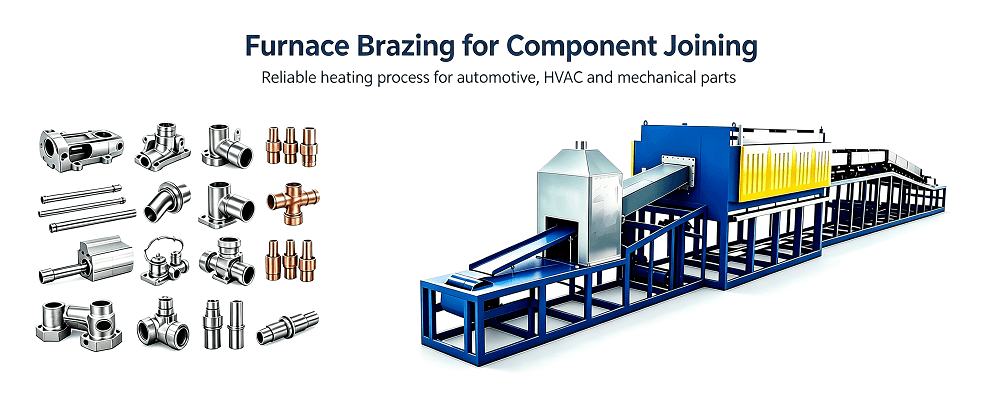
Applications Suitable for automatic continuous brazing and bright annealing of copper, stainless steel, carbon steel, aluminum, new energy storage components, liquid cooling plates and IGBT modules. It is the ideal equipment for high-efficiency, low-labor standardized large-scale brazing production.
2.4 Supporting Equipment: Heater vs Complete Brazing Machine
A standalone brazing heater only provides heat sources and cannot operate independently. A complete industrial brazing machine integrates heating units, atmosphere control, conveyor system, intelligent temperature control and sealed cooling systems to finish standardized full-process brazing and meet industrial mass production standards.
2.5 Batch Brazing Oven
Batch brazing ovens are chamber-type intermittent brazing devices designed for small-batch, multi-specification customized production. With flexible adjustable temperature, holding time and atmosphere parameters, they are ideal for trial production and custom brazing services.
Working Principle Workpieces are loaded in batches inside a fully sealed chamber with customized protective gas. Integral uniform heating completes synchronous brazing for each batch. Independent single-cycle operation supports flexible switching of different product specifications and process requirements.
3. Material-Based Brazing Furnace Selection Rules
3.1 Copper Brazing
Copper and brass materials are prone to high-temperature oxidation and discoloration. Continuous hydrogen brazing furnaces are optimal for large-scale mass production to retain bright metallic surfaces. Vacuum brazing furnaces are recommended for high-pressure, high-airtightness copper manifolds to eliminate internal pores and improve sealing performance.
3.2 Stainless Steel Brazing
Stainless steel forms stable chromium oxide layers at high temperatures. Two mature solutions are available: hydrogen brazing furnaces with dew point below -40°C for efficient oxide reduction and bright brazing; vacuum brazing furnaces for high-precision, flux-free, high-strength stainless steel joints.
3.3 Aluminum Alloy Brazing
Aluminum alloys cannot withstand high-temperature hydrogen environments. Professional aluminum brazing requires nitrogen-protected CAB furnaces with standard flux systems. For zero-residue high-end aluminum assemblies, customized vacuum aluminum brazing equipment is available for ultra-high process standards.
4. Verified Industrial Application Cases
Case 1: Vacuum Brazing for Stainless Steel Pipeline Assemblies
A Russian refrigeration component manufacturer upgraded from traditional flame brazing to our custom vacuum brazing furnace for stainless steel pipe fittings and hydraulic assemblies. After optimization, the leakage rejection rate dropped from 8.2% to below 0.4%, and post-brazing polishing workload reduced by 75%, greatly lowering production costs and improving product competitiveness.
Case 2: Continuous Brazing for Automotive Hardware
A Bangladesh automotive hardware factory adopted our hydrogen-atmosphere continuous brazing line for mass copper fitting production. The automated line achieves a stable daily output of 12,000 pieces with a pass rate above 99.3%, realizing high-quality, low-cost standardized mass production for automotive precision components.
Applications of Continuous Mesh Belt Brazing Furnace
5. Performance Comparison: Vacuum vs Continuous CAB Brazing Furnace
|
Comparison Item |
Vacuum Brazing Furnace |
Continuous CAB Brazing Furnace |
| Production Mode | Intermittent batch processing | 24h automatic continuous production |
|
Applicable Output |
Low & medium-volume precision batches |
High-volume mass production |
|
Operating Cost |
High (power & maintenance) |
Medium (low labor, moderate gas consumption) |
|
Surface Quality |
Flux-free, ultra-bright flawless finish |
Bright finish (flux needed for aluminum) |
|
Core Application |
Complex thin-wall & high-seal precision parts |
Standard mass-produced hardware fittings |
|
Investment Budget |
High initial investment |
Cost-effective & high cost-performance |
Continuous Brazing Furnace — Top View
6. Frequently Asked Questions
Q1: Difference between brazing furnace and brazing oven?
No strict technical boundary exists in industrial use. A brazing oven generally refers to small chamber-type batch equipment for trial and custom production. A brazing furnace is a general industrial term covering vacuum, atmosphere and continuous tunnel furnaces for full commercial and industrial scenarios.
Q2: How to choose reliable brazing furnace manufacturers?
Trusted manufacturers own independent R&D, customization and after-sales capabilities, supporting personalized adjustment of furnace size, temperature zones and atmosphere systems. We provide one-stop solutions including customization, manufacturing, installation, commissioning and long-term technical services.
Q3: Can a single brazing heater work independently?
No. A standalone heater only provides heat source. Without sealed furnace body, atmosphere/vacuum system and intelligent temperature control, it cannot prevent oxidation or meet industrial brazing precision standards.
7. Conclusion & Purchase Recommendations
For global manufacturing buyers, targeted furnace selection directly determines production efficiency and product quality:
• High-precision & high-airtightness parts: Choose a vacuum brazing furnace
• Mass copper & stainless steel production: Choose a continuous hydrogen brazing furnace
• Automotive & new energy aluminum heat exchangers: Choose a dedicated CAB aluminum brazing furnace
• Small-batch custom processing: Adopt a batch brazing oven
If you are sourcing high-quality brazing furnaces or need custom brazing process solutions, contact our engineering team for professional parameter configuration and factory quotations.
If you’re interested in our heat treatment furnaces or customized solutions, contact us for professional support and tailored quotations. We look forward to long-term win-win cooperation.